
What is the one rule behind every face-shape chart?
Every "sunglasses for face shape" chart you've ever seen boils down to a single principle: the frame should contrast with your face's geometry, not repeat it. Curved features get structure from angular frames. Angular features get softness from curved frames. Balanced features can borrow from either side.
That's it. Everything below is that rule applied to six face shapes, plus the exceptions worth knowing. If you're not sure which shape you have, the width comparison in our face shape guide for glasses works identically for sunglasses — or an AI face scan can measure it for you in about ten seconds.
| Face shape | Wear | Skip |
|---|---|---|
| Round | Square, wayfarer, clubmaster, cat-eye | Small round lenses, circular wire frames |
| Square | Round, oval, aviator, rimless | Boxy rectangles, hard-cornered frames |
| Oval | Almost anything — wayfarer, aviator, oversized | Frames wider than your cheekbones |
| Heart | Aviator, round, bottom-heavy, rimless | Top-heavy styles, bold browlines |
| Diamond | Cat-eye, oval, browline, rimless | Narrow frames that pinch at the cheekbones |
| Oblong | Oversized, deep square, wraparound | Small, narrow, shallow lenses |
What sunglasses suit a round face?
A round face has soft curves, full cheeks, and roughly equal width and length. Dark lenses amplify the softness, so the frame's job is to add lines the face doesn't have.
Why it works: sharp corners and straight top lines create the illusion of cheekbone structure and a longer face. A wayfarer's trapezoid does this without looking severe; a clubmaster's bold browline pulls attention up and away from the cheeks. Cat-eye shapes lift the whole face. The one trap: tiny round lenses — think retro teashades — repeat every curve your face already has and shrink against full cheeks.
What sunglasses suit a square face?
A square face has a strong jawline, wide forehead, and angular corners. It photographs powerfully — and hard rectangular sunglasses can push it toward harsh.
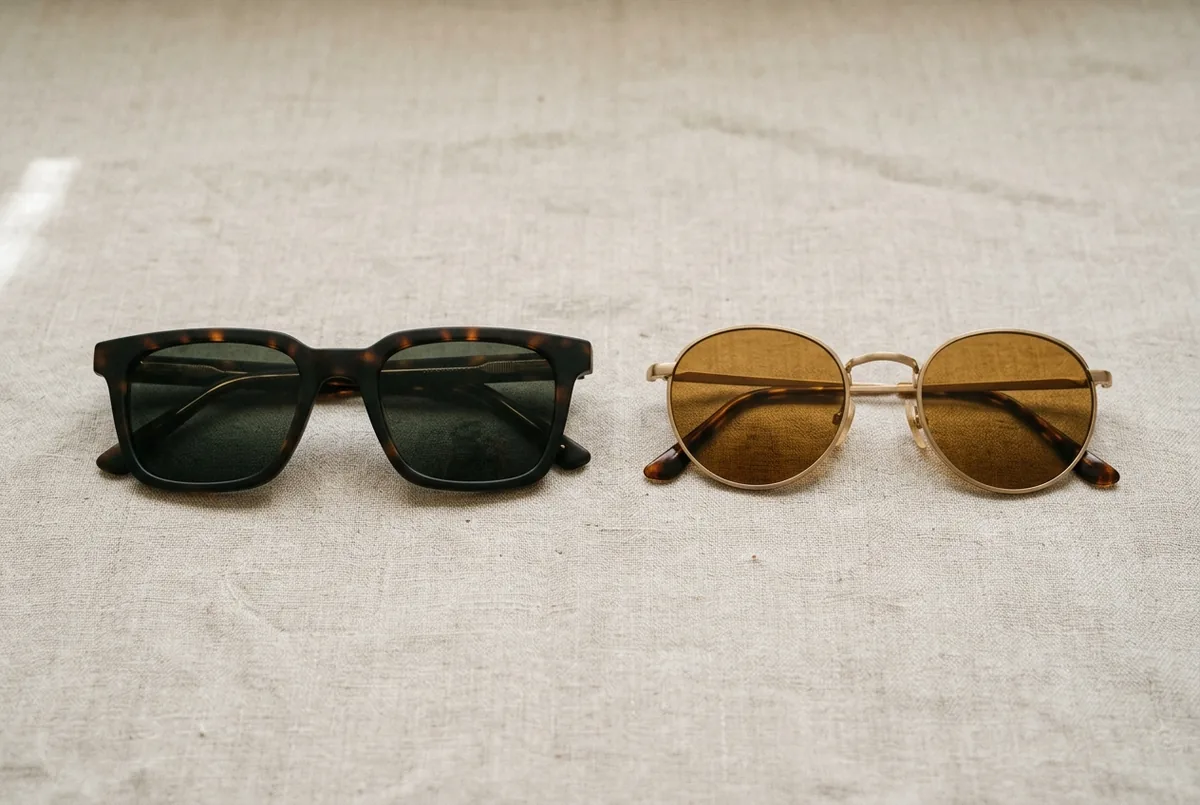
Why it works: curved lenses soften the jaw's angles instead of echoing them. Aviators are the square face's best friend — the teardrop shape adds curve exactly where the face is most angular, and the thin metal frame keeps things light. Round acetate frames in a warm tortoise read relaxed rather than stern. Rimless styles remove visual hardware entirely and let the curve of the lens do the softening.
What sunglasses suit an oval face?
An oval face — slightly longer than wide, balanced forehead and jaw, gently curved lines — is the shape every chart calls "lucky." Mostly true: balance tolerates contrast in either direction.
The real question for oval faces isn't shape — it's scale. Frames that extend past your cheekbones throw off the proportions that make the shape work. Since nearly everything suits you, use the freedom to pick by lens size and personality: bold oversized acetate for presence, slim metal for restraint. This is also the face shape where trend styles — shield lenses, sport wraps — are safest to experiment with.
What sunglasses suit a heart-shaped face?
A heart face is widest at the forehead and tapers to a narrower chin. The instinct to balance it is correct: the goal is to keep visual weight low and light.
Why it works: aviators taper exactly the way the face does — wider at top, narrower at bottom — but their thin frame doesn't add forehead weight the way a thick browline would. Round lenses draw the eye toward the middle of the face rather than the brow. Frames with a darker or heavier lower rim add presence near the chin, evening out the taper. Clubmasters, great on round faces, are the classic mistake here: all their weight sits at the widest part of yours.
What sunglasses suit a diamond face?
A diamond face is widest at the cheekbones with a narrower forehead and jaw. It's the rarest shape, and the strategy is to widen the top of the face while showing off the cheekbones.
Why it works: cat-eye and browline styles add width at the brow, balancing the cheekbones' dominance. Oval lenses keep everything soft. The frame's total width should roughly match your cheekbone width — a frame that pinches inward at the widest point of your face highlights exactly the wrong contrast.
What sunglasses suit an oblong face?
An oblong face is clearly longer than it is wide, with fairly straight sides. Sunglasses are actually an advantage here: a big dark lens visually breaks up length better than any optical frame.
Why it works: depth is the key measurement — a tall lens covers more vertical face, shortening its apparent length. Oversized squares and deep wayfarers do this best. Decorative or thick temples add width at eye level, which also helps. Small narrow lenses are the worst case: they leave the length untouched and sit like a dash in the middle of it.
How do you test the rules on your own face?
Face-shape rules are honest heuristics, not laws — real faces sit between categories, and hair, brows, and skin tone all shift what works. The face-shape chart narrows twenty styles down to five candidates; the only reliable way to pick between those five is to see them on your face.
That used to mean an afternoon at a sunglasses rack. Now it doesn't. AI virtual try-on renders any pair on a 3D scan of your face — and because modern try-on is ~90% accurate on shape and silhouette, it answers exactly the question this article raises: does this geometry flatter this face? With Frame you can import sunglasses from any brand's site — Ray-Ban, Persol, Oakley, a boutique label — and compare them side by side on your own face, in seconds, for free.
See any sunglasses on your face in seconds
Scan once. Import from any brand. Compare side by side.
Download Frame for iOS